Software Publications People
Databases are continuously evolving environments, where design constructs are added, removed or updated rather often. Small changes in the database configurations might impact a large number of applications and data stores around the system: queries and data entry forms can be invalidated, application programs might crash. A data-intensive ecosystem comprises a central database and all the software modules and applications that base their operations on it: forms, reports, stored procedures, workflows, etc. HECATAEUS is a tool that represents the database schema along with its dependent views and queries (acting as an abstraction for all the above software modules) as a uniform directed graph. The tool enables the user to create hypothetical evolution events and examine their impact over the overall graph as well as to define rules so that both syntactical and semantic correctness of the affected workload is retained.
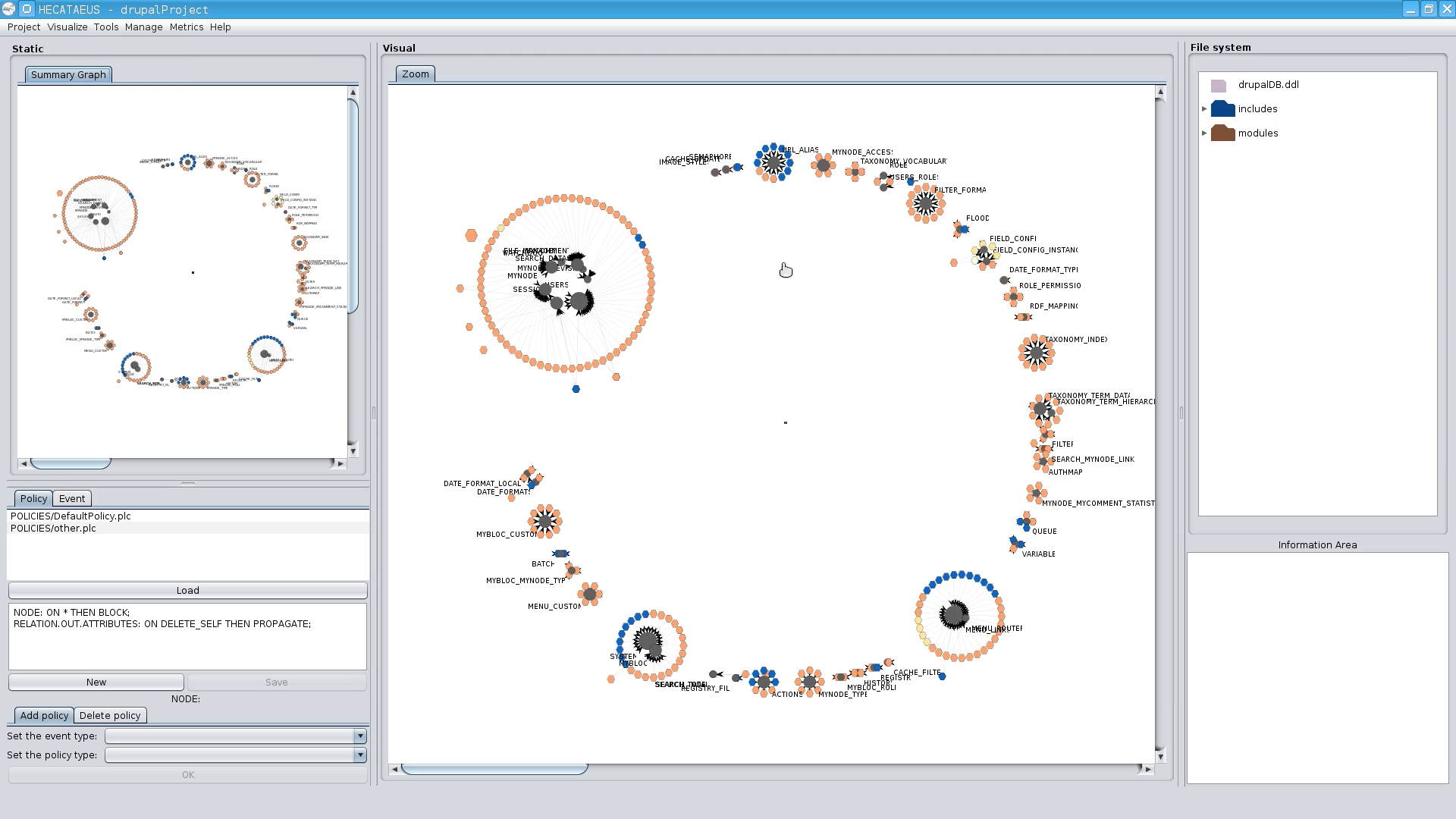
Our approach is to provide a mechanism for performing impact analysis for potential changes of database configuration. A graph model that uniformly models queries, views, relations and their significant properties (e.g., attributes, conditions) is the basis of the approach. Apart from the simple task of capturing the semantics of a database system, the graph model allows us to predict the impact of a change over the system. Furthermore, we provide a framework for annotating the database graph with policies concerning its behavior in the presence of hypothetical changes occurring in the database schema. Rules that dictate the proper actions, when additions, deletions or modifications are performed to relations, attributes and conditions (all treated as first-class citizens of the model) are provided. Specifically, assuming that a graph construct is annotated with a policy for a particular event (e.g., a relation node is tuned to deny deletions of its attributes), Hecataeus performs the identification of the affected part of the graph. Moreover, Hecataeus is equiped with capabilities of computing important graph-based metrics that characterize the importance or vulnerability of each node of the graph.
Sources
You can retrieve all the source code of Hecataeus via Github [link here]
Hecataeus has undergone several versions. Specifically:
- v01: George Papastefanatos' Phd, JoDS 2009
- v02: ICDE 2010
- v03: Extension with PL/SQL parser, June 2010
- v04: Petros Manousis' MSc, Feb 2013
Examples and Demos
- A video from the ER 2014 version of Hecataeus (Hecataeus_ER2014.webm) viewable from all the typical web browsers. Explanations are also available in the following set of screenshots.
- Screenshots of Hecataeus in Action
- A zipped folder with examples and policies for (a) TPC-H and (b) a simple EMP-WORKS-PROJ example (.rar 3K)
- Poster (pdf)
- [OLD v.] A video from the CSMR 2008 demo of Hecataeus (.rar 13.3 MB, uncompressed: 594 MB)
License
This software is available under the GNU GPL v.3 licence. The software and documentation made available under the terms of this license are provided with no warranty.
Originally, this work was licensed under a Creative Commons Attribution-Noncommercial-Share Alike 3.0 Greece License. This was much better, because one could very easily understand what is allowed and what is prohibited. However, since Creative Commons discourages the usage of its licencing for software products, we had to switch.
For local copies of these paper, slides of their presenations, long versions and any other additional material, you can always visit my local publications page.
- Petros Manousis, Panos Vassiliadis, George Papastefanatos. Impact Analysis and Policy-Conforming Rewriting of Evolving Data-Intensive Ecosystems. Journal on Data Semantics, vol. 4, no. 4, pages 31-267, doi: 10.1007/s13740-015-0050-3, 2015.
- Efthymia Kontogiannopoulou, Petros Manousis, Panos Vassiliadis. Visual Maps for Data-Intensive Ecosystems. Proceedings of 33rd International Conference on Conceptual Modeling (ER 2014), Atlanta, GA, USA, October 27-29, 2014. pp. 385-392.
- Petros Manousis, Panos Vassiliadis, George Papastefanatos. Automating the adaptation of evolving data-intensive ecosystems.. 32nd International Conference on Conceptual Modeling (ER 2013). 11-13 November 2013, Hong Kong, China.
- George Papastefanatos, Panos Vassiliadis, Alkis Simitsis, Yannis Vassiliou. Metrics for the Prediction of Evolution Impact in ETL Ecosystems: A Case Study. Journal of Data Semantics, volume 1, number 2, pp. 75-97, 2012, ISSN 1861-2032, DOI 10.1007/s13740-012-0006-9, Springer.
- Panos Vassiliadis. RADAR: Radial Applications’ Depiction Around Relations For Data-Centric Ecosystems. In 1st International Workshop on Managing Data Throughout its Lifecycle (DaLi 2011) in conjunction with ICDE 2011, pp. 62-67, April 11, 2011, Hannover, Germany.
- George Papastefanatos, Panos Vassiliadis, Alkis Simitsis. Propagating Evolution Events in Data-Centric Software Artifacts. In 3rd Workshop on Hot Topics in Software Upgrades (HotSWUp 2011), in conjunction with ICDE 2011, pp. 162-167, April 16, 2011, Hannover, Germany.
- George Papastefanatos, Panos Vassiliadis, Alkis Simitsis, Yannis Vassiliou. HECATAEUS: Regulating schema evolution.In Proc. IEEE 26th International Conference on Data Engineering (ICDE 2010), pp: 1181-1184, 1-6 March 2010, Long Beach, CA.
- G. Papastefanatos, P. Vassiliadis, A. Simitsis, Y. Vassiliou. Policy-regulated Management of ETL Evolution. Journal on Data Semantics (JoDS), Special issue on "Semantic Data Warehouses" (JoDS XIII), LNCS 5530, pp. 146-176, 2009, Springer.
- G. Papastefanatos, P. Vassiliadis, A. Simitsis, T. Sellis, Y. Vassiliou. Rule-based Management of Schema Changes at ETL sources. Workshop on Managing Evolution of Data Warehouses (MEDWa 2009), September 7, 2009, Riga, Latvia.
- G. Papastefanatos, P. Vassiliadis, A. Simitsis, Y. Vassiliou. Design Metrics for Data Warehouse Evolution. 27th International Conference on Conceptual Modeling (ER '08), LNCS 5231, Barcelona, Spain, October 20-23, 2008.
- G. Papastefanatos, P. Vassiliadis, A. Simitsis, K. Aggistalis, F. Pechlivani, Y. Vassiliou. Language extensions for the automation of database schema evolution. 10th International Conference on Enterprise Information Systems (ICEIS 2008), pp. 74-81, 12 - 16 June 2008, Barcelona, Spain.
- G. Papastefanatos, F. Anagnostou, Y. Vassiliou, P. Vassiliadis. Hecataeus: A What-If Analysis Tool for Database Schema Evolution. 12th European Conference on Software Maintenance and Reengineering (CSMR 2008), pp: 326-328, April 1-4, 2008, Athens, Greece.
- G. Papastefanatos, P. Vassiliadis, A. Simitsis, Y. Vassiliou. What-If Analysis for Data Warehouse Evolution. In Proc. 9th International Conference on Data Warehousing and Knowledge Discovery 2007 (DaWaK 2007), pp. 23-33, Regensburg, Germany, 3-7 September 2007.
- G. Papastefanatos, P. Vassiliadis, Y. Vassiliou. Adaptive Query Formulation to Handle Database Evolution. In Proc. Forum of the 18th Conference on Advanced Information Systems Engineering (CAiSE Forum 2006), Luxembourg June 5-9, 2006.
 |
 |
 |
 |
 |
| Panos Vassiliadis | George Papastefanatos | Petros Manousis | Alkis Simitsis | Yannis Vassiliou |
Past members: Kostis Kyzirakos, Fotini Anagnostou, Konstantinos Aggistalis, Fotini Pechlivani, Stefanos Geraggelos, Efthymia Kontogiannopoulou
Last update: 2013/02/22
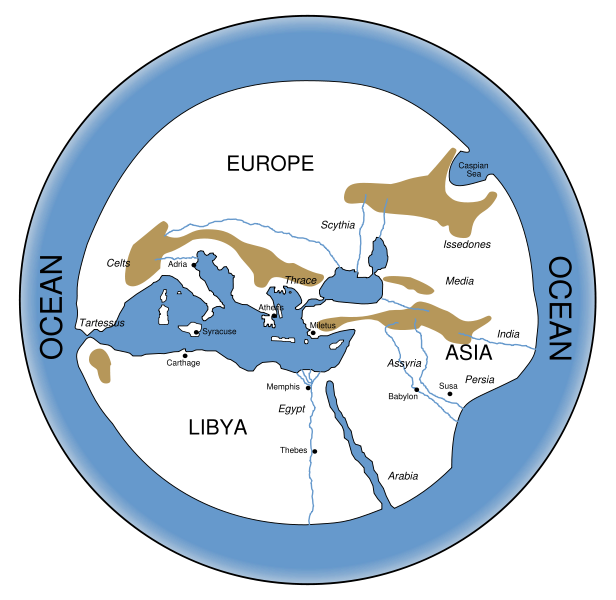
Hecataeus of Miletus (c. 550–c. 476 BC), was a Greek philosopher,one of the first Greek historians and the first to produce an adequate visualization of the part of the Earth known to the Greeks at his time, i.e., a map. The logo of this page is from http://en.wikipedia.org/wiki/Image:Hecataeus_world_map-en.svg